



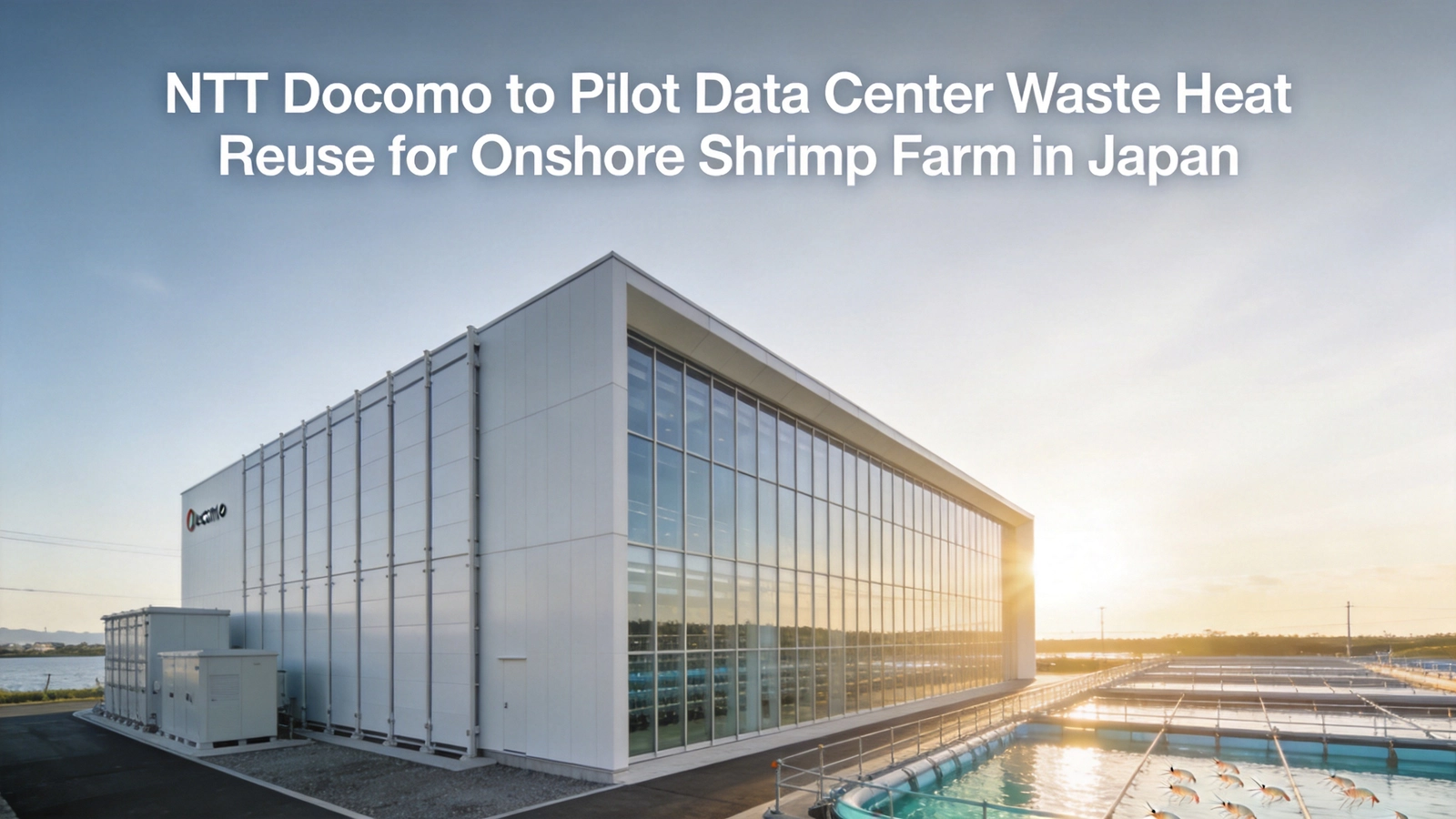
NTT said the project aims to "demonstrate a new option for utilizing waste heat from data centers, which has previously had limited uses due to its relatively low temperature, by using it for food production." The four participating companies—which also include Hibiya General Equipment and NTT Green & Food—intend to verify the cost-reduction effects and business viability of land-based aquaculture powered by data center waste heat, with the broader goal of establishing a replicable business model that can be deployed at other data center sites.
Under the division of responsibilities, IMT Engineering will design the land-based aquaculture system, NTT Docomo will supply the data center facility, Hibiya General Equipment will handle the design and construction of waste heat recovery and heat supply equipment, and NTT Green & Food will oversee the aquaculture operations and evaluate the effectiveness of reducing production costs through the use of data center waste heat. NTT Green & Food, established in 2023 alongside regional fisheries operator Regional Fish, produces and sells eco-friendly fish and shellfish as well as the algae used for their feed, primarily through land-based aquaculture.
The project forms part of a Tokyo Metropolitan Government initiative supporting demonstration projects that explore ways to utilize waste heat and other unused thermal energy from data centers. Other participants in the program include KDDI, which is working with ElleThermo to deploy a self-powered temperature sensing system capable of generating electricity from low-grade heat of around 20-40°C, and Kratwerk Co. and Tokyu Construction Co., which are using waste heat from a small modular data center located beneath a railway overpass for server cooling.
The pilot reflects a growing industry interest in finding agricultural and industrial applications for data center waste heat, which has historically been difficult to repurpose because of its relatively low temperature. Similar efforts have been undertaken internationally, including by Equinix in Paris, EcoDataCenter in Sweden in partnership with circular economy firm Wa3rm, and Block Heating in the Netherlands, which operates a facility co-located with a greenhouse growing tomatoes. In Japan, the White Data Center uses waste heat to cultivate eels, while Green Mountain supplies warmth to a local lobster farm in Norway and Data4 has experimented with using waste heat to grow algae in France.
NTT Docomo currently operates data centers around Tokyo, Yokohama, Osaka, and Kagawa under the Nexcenter brand, in addition to facilities in Shanghai and Hong Kong. The shrimp farming pilot represents an attempt to convert what is typically treated as an environmental liability into a resource for food production, potentially offering data center operators a new avenue for improving energy efficiency and community engagement as scrutiny of the sector's power consumption intensifies.