





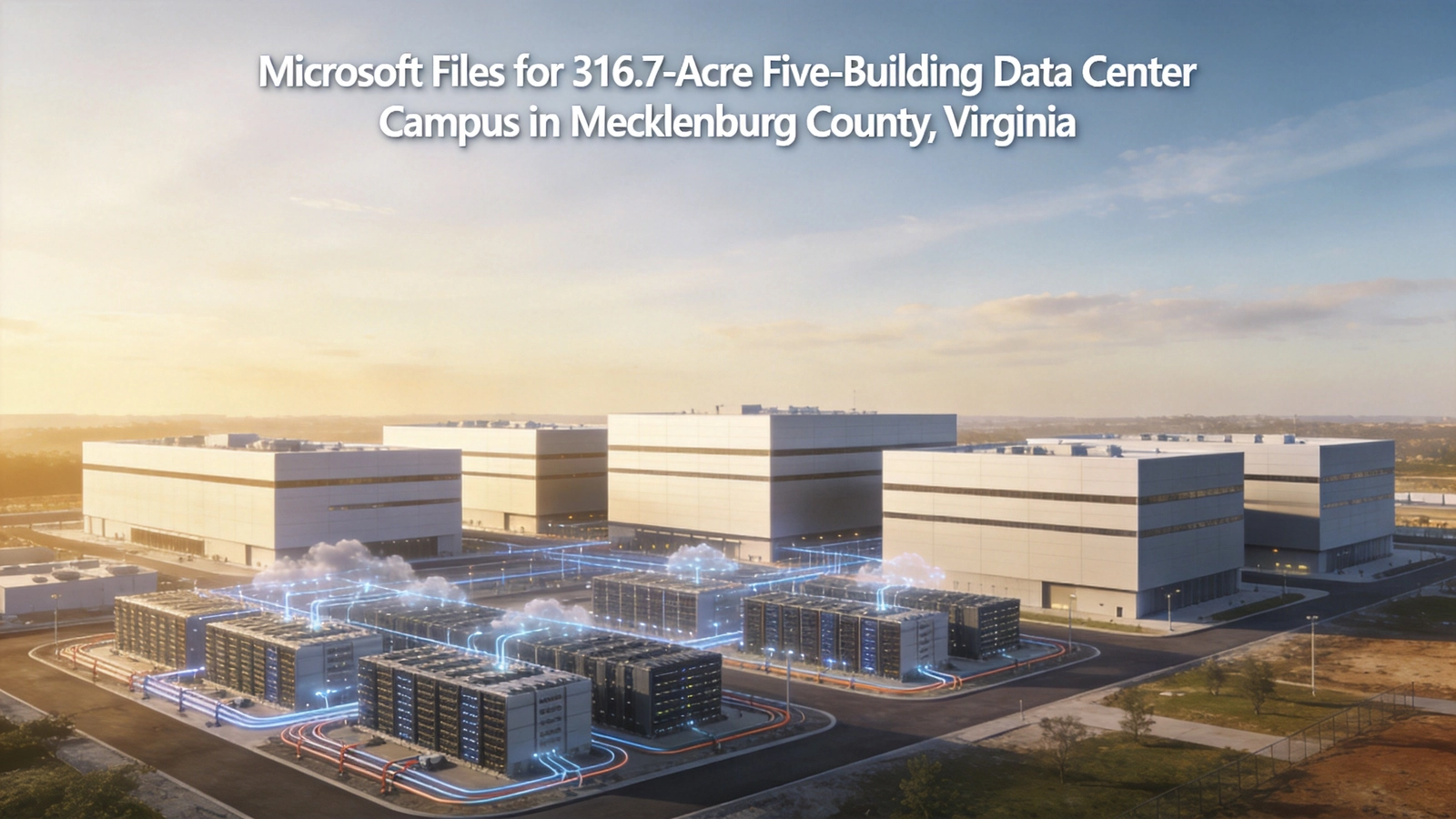
The application states that the campus will be used to "generate cloud storage and computing operational capacity" and to "address expanding customer demand for cloud platform services in the region." The Norfolk District is accepting public comments on the application until December 19, 2026.
The filing follows another significant Microsoft application earlier this year for a 490-acre campus in Mecklenburg County, which is planned to include three data center buildings. Mecklenburg County already hosts a substantial number of Microsoft data centers, all operating within the company's southern Virginia Regional Network Group. Between 2022 and 2023, Microsoft filed for three additional campuses in the area, including a 369-acre site north of Butler Farm Road, a 132-acre parcel at 210 Tunstall Road featuring three buildings, and a 259-acre site at Lakeside Commerce Park, also housing three buildings.
Microsoft's presence in Mecklenburg County dates back more than a decade. The company's longstanding Boydton campus was first announced in 2010 and built at a cost of nearly $500 million, at the time hailed as the largest economic investment in Southern Virginia history. The facility was expanded repeatedly between 2011 and 2016, and in June 2023 Microsoft signed a 24/7 nuclear power agreement with Constellation to supply the Boydton campus. The company operates two Azure cloud regions in Virginia — East and East 2 — along with two government-dedicated zones known as US DoD East and US Gov Virginia.
The continued expansion carries significant implications for the regional economy and the data center industry at large. Mecklenburg County's central location, within an hour and a half of Richmond, Virginia, and Raleigh, North Carolina, and two and a half hours from Norfolk, Virginia, has made it an increasingly attractive destination for hyperscale development. The new campus adds to a growing concentration of digital infrastructure in southern Virginia, reinforcing the region's status as a critical hub for cloud computing capacity on the East Coast. As demand for AI workloads and cloud services continues to accelerate, Microsoft's successive filings signal that the company intends to maintain its aggressive buildout pace in the area for years to come.