



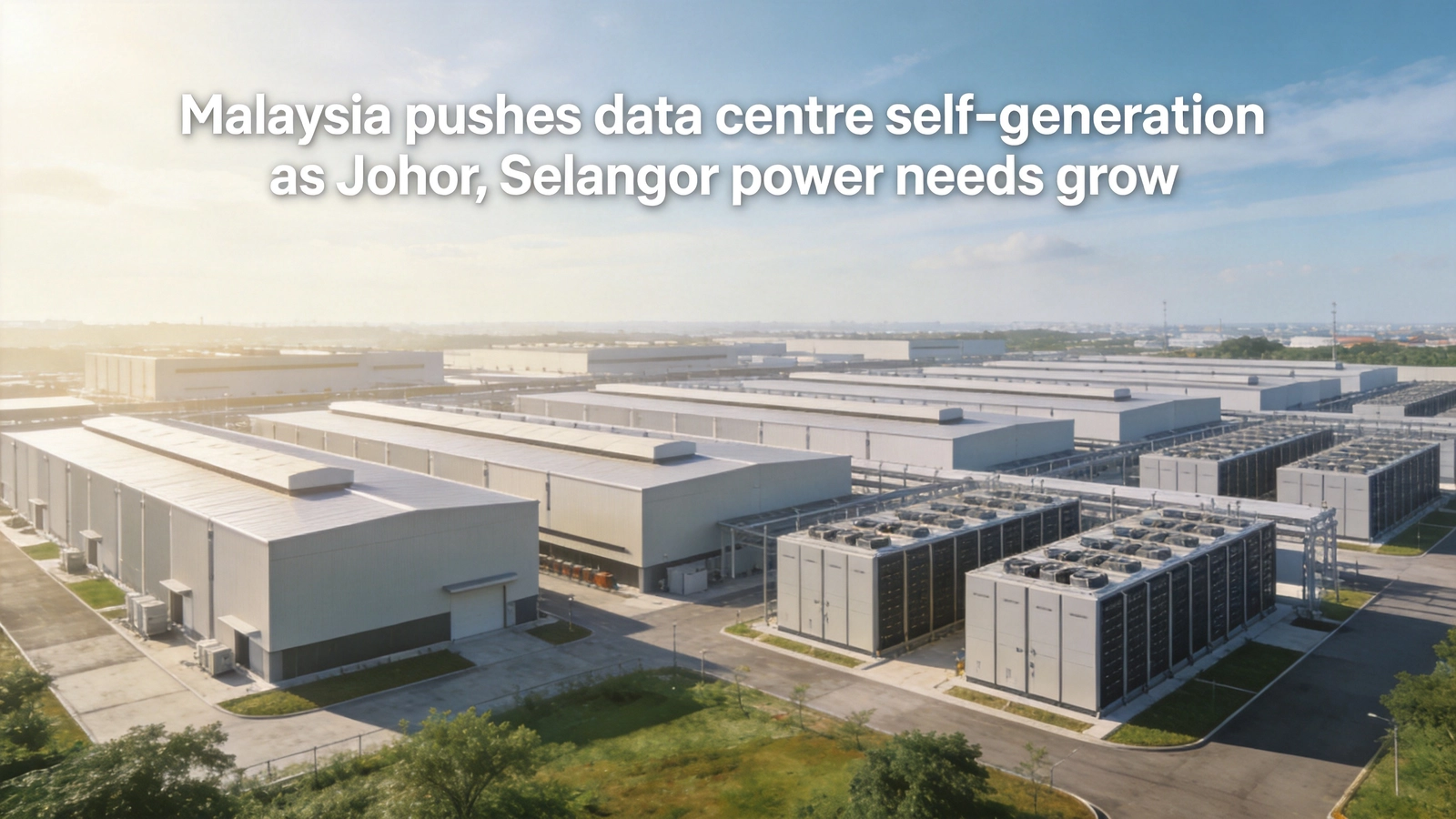
The policy push comes as the Ministry of Energy Transition and Water Transformation projects that peak electricity demand from data centres in Peninsular Malaysia will reach 8.39 gigawatts by 2030 under current planning estimates. Johor is expected to account for 4.42GW and Selangor 1.48GW, together representing roughly 70% of the projected total. Fadillah added that data centres should be equipped with backup generators capable of managing demand during critical periods, particularly when electricity operating reserves run low.
Beyond power supply, developers are barred from siting data centres in areas with critically low water reserve margins, while operators must provide on-site water storage sufficient for at least two days of use. The National Water Services Commission requires developers to explore alternative cooling sources, including reclaimed water, recycled water and rainwater harvesting.
On current demand, Fadillah said contracted demand from data centres stood at 2,346 megawatts as of August 2026, while actual usage was 1,374MW, or 58.5% of the contracted figure, noting that estimates submitted during supply applications did not necessarily match eventual consumption. Every application undergoes a technical assessment by the Energy Focus Group before referral to the Data Centre Task Force, taking into account available supply, transmission and distribution networks, and infrastructure investment requirements.
Alongside self-generation, operators are being encouraged to participate in the Corporate Renewable Energy Supply Scheme (CRESS), which allows renewable energy developers to supply corporate consumers through the existing grid. In September, the ministry announced a CRESS acceleration package offering a system access charge of 14 sen per kilowatt-hour for firm supply, with a minimum contract period of 10 years and a requirement that eligible projects begin commercial operations by Dec 31, 2028. The Energy Commission later clarified that eligible developers would receive the fixed 14 sen per kWh rate for 10 years, while green electricity consumers would pay a separate four sen per kWh charge under the prevailing Regulatory Period 4 tariff, with supplementary amendments to the CRESS guidelines expected by November.
The charges drew scrutiny during Tuesday's parliamentary debate on the ministry's allocation under Budget 2027, with Yeo Bee Yin arguing that the effective cost of delivering electricity was 18 sen per kWh. Fadillah said the government was prepared to re-engage industry players on improvements to the fee structure, and the ministry has maintained that CRESS-related costs should be allocated reasonably to programme beneficiaries without being unfairly passed on to other electricity consumers.
On longer-term options, Fadillah said nuclear energy remained under government consideration, with national preparedness, supply security and public safety taking priority. International agreements would need to be addressed first, alongside compliance with International Atomic Energy Agency standards on safety regulation, workforce capacity and technological suitability. The government, he added, would facilitate business-to-business cooperation between electricity suppliers and data centre operators interested in exploring nuclear energy, subject to the necessary requirements.