





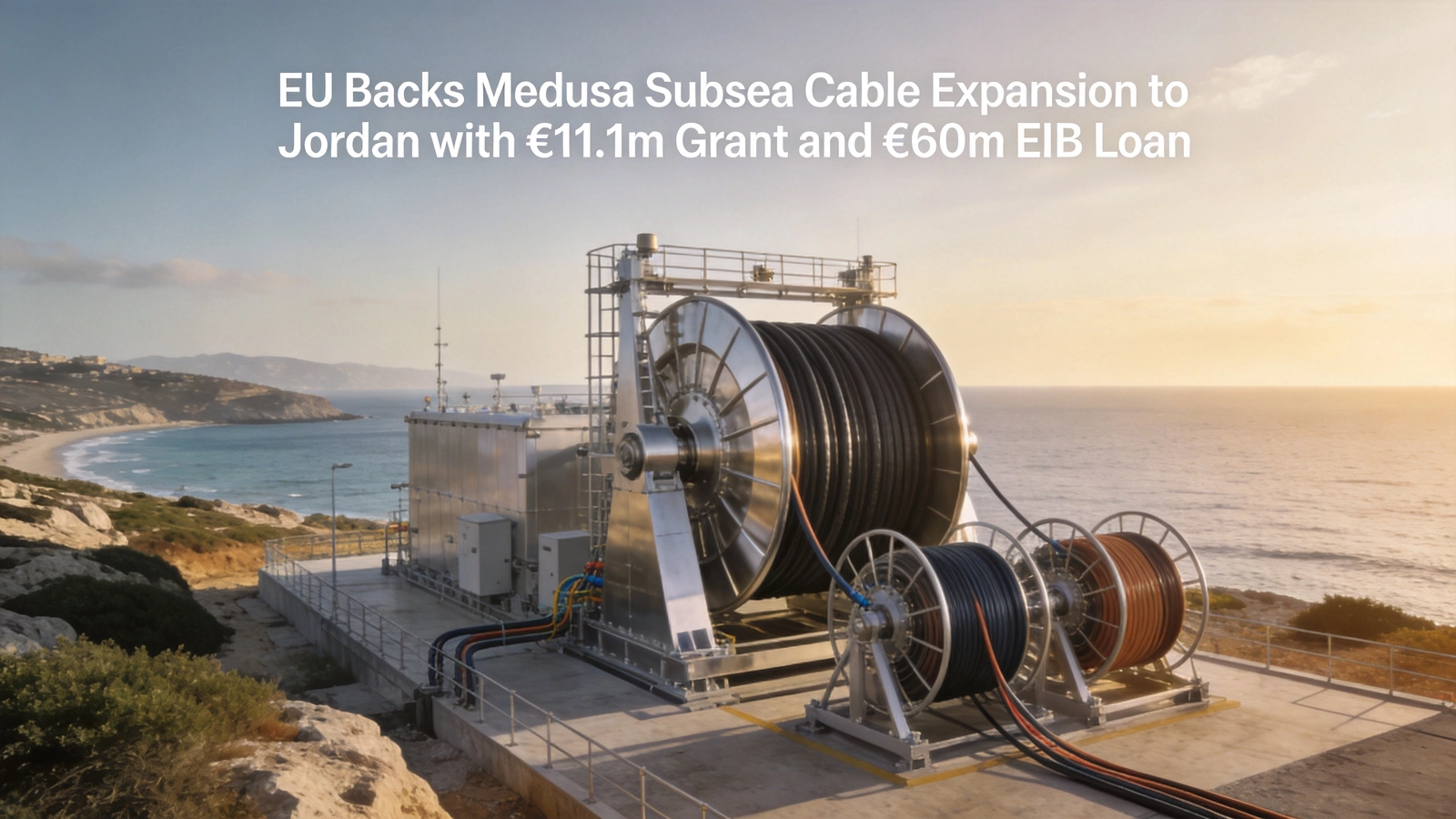
The new EU support builds on previous funding commitments. The European Union has already granted Medusa €40 million through the Neighbourhood Investment Platform. According to the EIB, the grant is specifically aimed at improving connectivity for research and education. Working in partnership with GEANT, Europe's research and education networking organization, the project seeks to connect around 500 institutions across the Southern Mediterranean with their European counterparts, facilitating data exchange, scientific collaboration and access to shared digital resources for universities and research centers.
Damien Bertrand, Chief Operating Officer of Medusa, said the project was conceived to bring the two shores of the Mediterranean closer together through better digital connectivity, adding that the new EU support reinforces that vision by enabling universities and research institutions across Europe, North Africa and Jordan to collaborate, exchange knowledge and access the digital resources they need.
EIB Vice President Gelsomina Vigliotti said reliable digital connections are essential for innovation, economic resilience and cooperation, and that the new connection would help Jordan's research and science communities share knowledge and collaborate more easily. She added that beyond research and science, the extension would help expand access to faster, more reliable digital connectivity for businesses and public services in Jordan.
EU Commissioner for the Mediterranean Dubravka Šuica said connecting Jordan to the Medusa submarine cable network would strengthen its digital links with Europe and the wider Mediterranean, noting that Jordan's research community has much to offer to Europe. She said faster, more reliable connections would make it easier for researchers at SESAME and for students and scientists at Jordanian universities to share data and work on joint projects with their European peers, while also helping Jordanian businesses reach new markets and improve access to public services through the Global Gateway and the Pact for the Mediterranean.
The first segment of the Medusa subsea cable went live in June, connecting France and Tunisia. Once fully deployed, the 8,700-kilometer system will span 19 landing sites across Europe and North Africa. First announced in 2022, the 24-fiber pair system is due to land in Spain, France, the Italian island of Sicily, Greece and Cyprus, as well as at multiple points along Africa's northern coast across Morocco, Algeria, Tunisia and Libya. Owned by AFR-IX Telecom, Medusa will run from the Carcavelos area of Lisbon in Portugal through the Mediterranean to Port Said, Egypt, and Aqaba, Jordan. An expansion to Syria is also planned, along with an extension down the West African coast landing in Gabon, the Democratic Republic of Congo and Guinea.
The financing arrangement highlights the growing role of multilateral development banks in funding subsea infrastructure that serves both commercial and public-interest objectives. For Jordan, the connection to Medusa represents a significant step toward deeper integration into European digital networks, with potential spillover benefits for its research institutions, enterprises and public services. The project also forms part of a wider trend of EU-backed connectivity initiatives in the Mediterranean region, where improved subsea capacity is seen as foundational to economic cooperation and scientific exchange.