



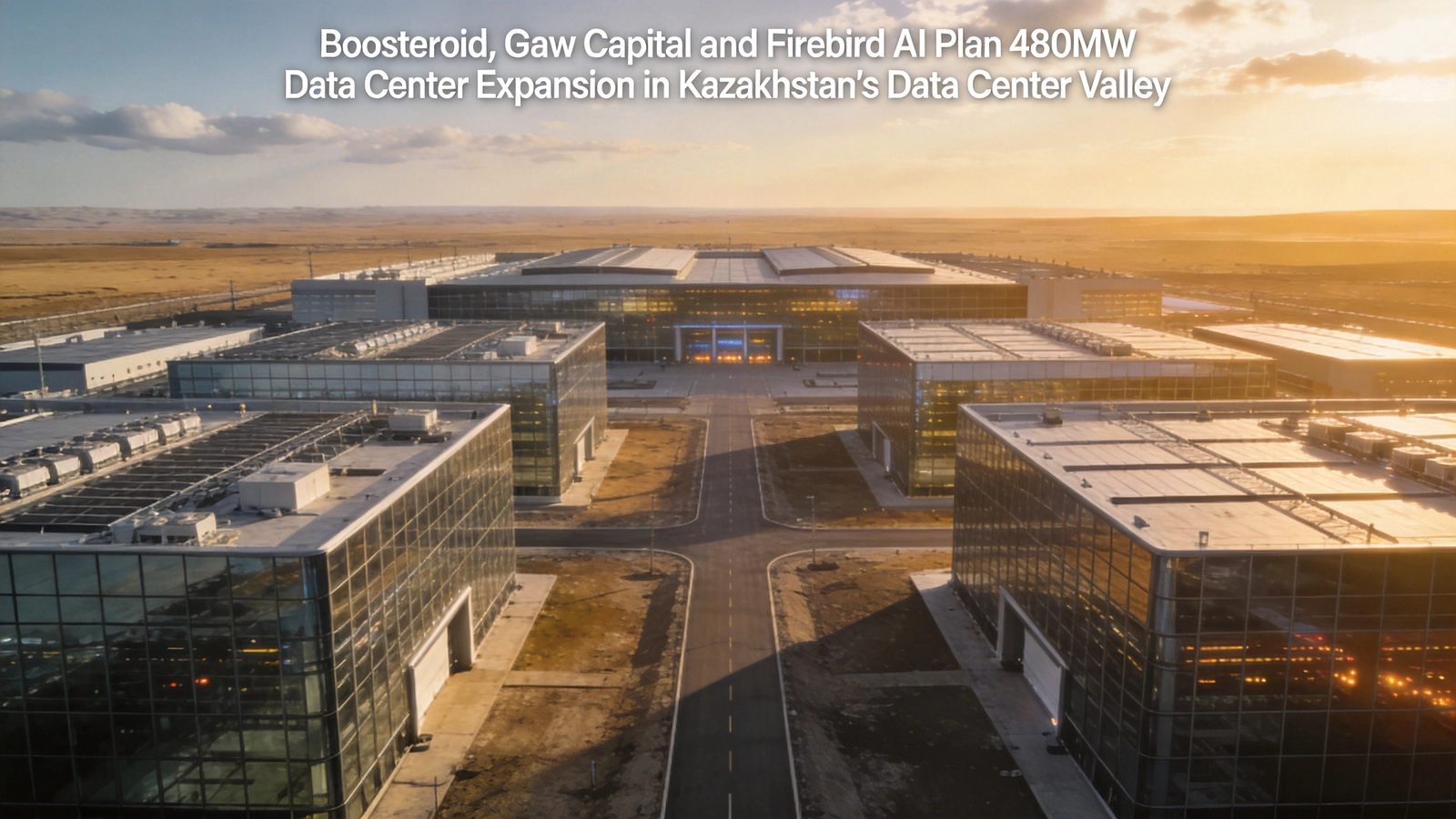
The newly announced phase two, involving Gaw Capital, Boosteroid and Firebird AI, targets 480MW and is designed to be expandable to 620MW. According to a notice from the Prime Minister of Kazakhstan, negotiations are also underway with Aleria, Energy Capital Global and China Energy for an additional 240MW of capacity, with the potential to scale to 420MW, and talks are already in progress for a third phase of the broader project.
The agreement brings together partners with distinct capabilities. Boosteroid is known for its cloud gaming services and, together with DL Invest Group, formed a joint venture in November 2025 with plans to establish 12 hyperscale data centers across Europe, the first of which is planned for Bielsko-Biała, Poland, offering up to 300MW. Earlier this year the pair signed a $2.5bn data center infrastructure agreement with Argentum AI, under which Argentum AI would deploy GPU infrastructure within their facilities. Firebird AI, an AI cloud startup, launched its Armenian AI data center in August, described as the largest such facility in the Caucasus region and expected to reach 300MW of total capacity by the end of 2027, built on the Nvidia DSX platform and powered by more than 70,000 Nvidia Rubin and Blackwell GPUs. Gaw Capital, headquartered in Hong Kong, is a private equity firm focused on real estate markets across Asia-Pacific, with investments spanning residential development, offices, malls, hospitality, warehouses and data centers.
The project underscores the growing appeal of Kazakhstan as an emerging data center destination. The country currently hosts just 19 data centers, according to DataCenterMap, but is attracting increasing interest: Akashi is developing a 100MW facility in the country, Chinese IT firm Maase is exploring development opportunities, and Veon broke ground on a facility in December 2025. For Boosteroid, Gaw Capital and Firebird AI, the Pavlodar expansion offers a foothold in a market with abundant energy resources and growing government support for digital infrastructure, though the country's limited existing ecosystem means the partners will need to build much of the supporting energy and connectivity infrastructure from the ground up.